
Physiotherapy for Knee Pain: When Exercise and Rehab Can Help
There's nothing more frustrating than having to think twice about every leg exercise because your knee might hurt.
Maybe squats have become uncomfortable, your knee aches after a run, or getting up from your desk leaves it feeling stiff. You take a few days off, feel better and return to training, only for the same pain to show up again.
So, should you keep moving, take a longer break or get it checked?
It depends on what's causing the problem. Physiotherapy for Knee Pain can help you understand why your knee hurts and work out what needs to change so you can get back to your usual activities. For some people, that means rebuilding strength after an injury. For others, it means adjusting their training before the problem gets worse.
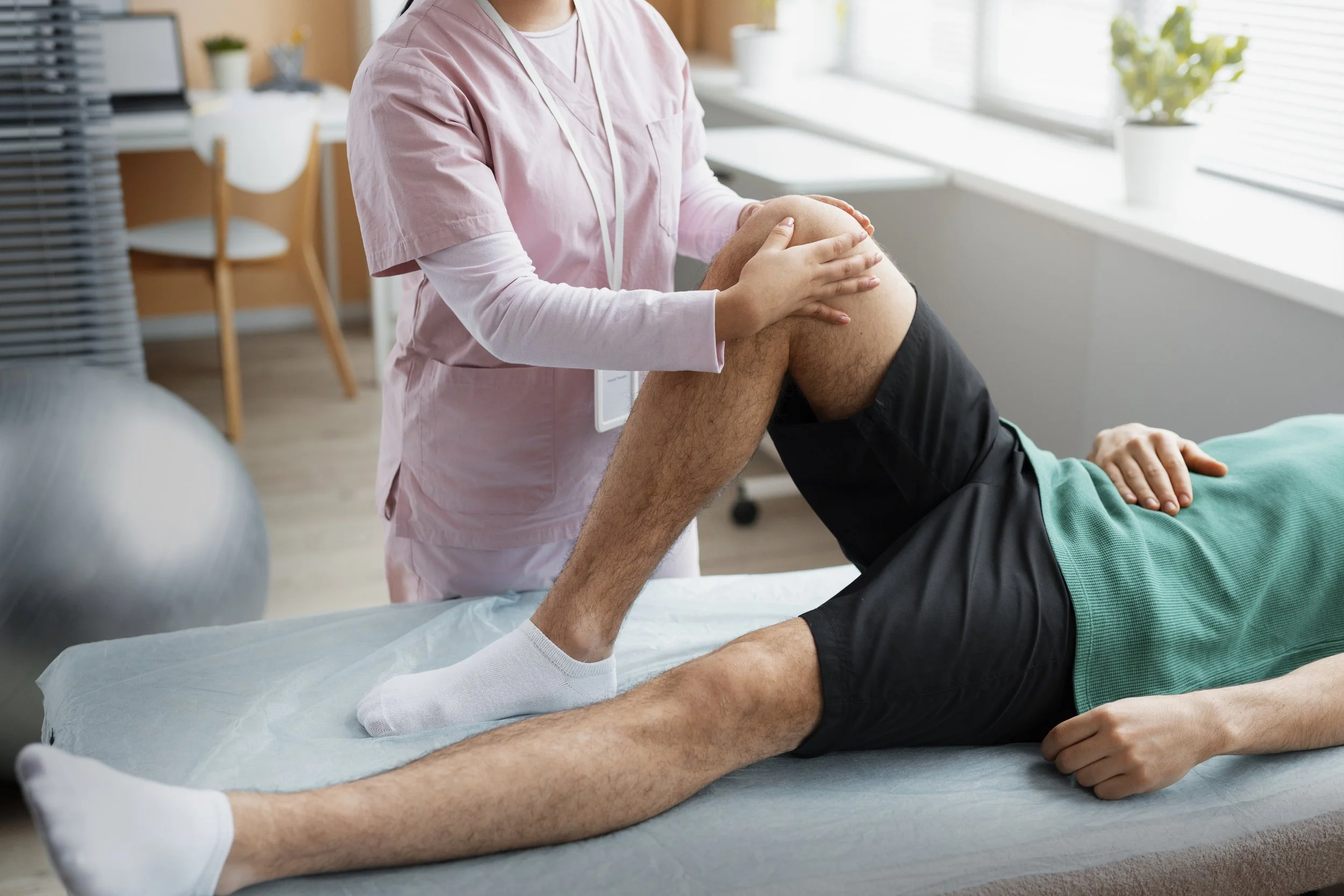
Why does your knee hurt?
Sometimes knee pain starts with one awkward landing or a sudden twist. Other times, it creeps up gradually. Nothing dramatic happens, but your knee starts hurting whenever you run, squat or climb stairs.
The details matter because different knee problems can feel quite similar.
Pain around the kneecap, for example, may be associated with patellofemoral pain. You might notice it during squats or lunges, going downstairs, or after sitting with your knees bent for a long time.
Pain just below the kneecap can involve the patellar tendon. This is often a concern for people who jump, sprint or increase their training load quickly.
A knee injury during football, basketball or another change-of-direction sport is a different situation. If your foot stays planted while your body twists, you could injure a ligament or the meniscus. Significant swelling, a feeling that the knee might give way, or difficulty straightening it should not be ignored.
Osteoarthritis can cause pain and stiffness too, particularly when walking or getting up after sitting.
The location of your pain gives your physiotherapist useful information, but it doesn't tell the whole story. Understanding when the pain started, what aggravates it and how your knee moves helps determine what to do next.
What happens when you see a knee physio?
Your first appointment should involve more than pointing to the sore spot and receiving a list of exercises.
At Pursuit Physiotherapy, the assessment considers how the problem started, what makes it worse and what you need your knee to do. Your daily routine matters just as much as your symptoms. Someone who spends hours on their feet has different demands from a person who wants to return to heavy squats or competitive sport.
Your physiotherapist may check knee movement, strength, balance and how you manage movements such as squatting or stepping down. Depending on your symptoms, your hip and ankle function may also be relevant.
Say your knee hurts every time you squat. Simply telling you to stop squatting doesn't explain why it hurts or what you should do instead. The assessment helps identify how your knee responds to movement and load, so your rehabilitation has a clear starting point.
Some knee problems can be managed with physiotherapy. Others need medical review or further investigation. If your symptoms suggest a more serious injury, getting the right assessment comes before progressing through exercises.
Can exercise help knee pain?
In many cases, yes. But the exercises need to suit the problem.
When your knee hurts, you naturally start avoiding things. You skip leg day, stop running or take the stairs less often. That can be sensible for a short time, particularly after an injury. Over time, though, reduced activity can leave you with less strength and fitness than you had before.
Then, when you return to your normal routine, your knee may struggle with the workload.
This is where knee rehabilitation can help. Depending on your assessment, your programme might include quadriceps strengthening, hip exercises, balance work or gradually increasing resistance.
The later stages should relate to what you're trying to get back to. A runner may need to progress towards hopping and running drills. Someone returning to football needs to prepare for sprinting, landing and changing direction. If your goal is to lift heavy, your rehabilitation eventually needs to build towards handling those loads.
You don't need to start with complicated exercises. Sometimes the first step is finding a version of a movement you can manage comfortably, then building from there.
At Pursuit Physiotherapy, strength-based rehabilitation focuses on improving your ability to handle the demands of everyday life, exercise and sport. Progress depends on how your knee responds, not simply how many exercises you've completed.
Do you need to stop going to the gym?
Not necessarily.
If squats aggravate your knee, you may be able to adjust the depth, reduce the weight or temporarily choose another exercise. If running is the problem, reducing your distance or speed may help you stay active while the knee settles.
Some injuries do require a break from particular movements. The point isn't to push through pain at all costs. It's to work out what you can reasonably continue doing without aggravating the problem.
For regular gym-goers, this can be especially important. Taking time away from training without knowing how or when to return can leave you guessing. A knee physiotherapy can help you make practical adjustments and gradually build your workload again.
What about knee wraps for lifting?
If you regularly squat or train with heavy weights, knee wraps may be something to consider.
At Pursuit Physiotherapy, knee wraps are available for people who want additional support during their lifting sessions. Wraps provide compression around the knee and can change how the knee feels during a squat, but they aren't a treatment for every cause of knee pain.
If your knee hurts under load, don't rely on wraps to push through it. The underlying problem still needs attention, and your training may need to change while you work on strength and recovery.
Knee wraps may have a place in your lifting routine, but they work best as part of a sensible approach to training rather than as a substitute for rehabilitation.
How long does knee rehabilitation take?
It would be convenient if every knee problem came with a clear recovery date. Unfortunately, they don't.
A mild flare-up after increasing your running may settle relatively quickly. A significant ligament injury or recovery after knee surgery can take considerably longer.
Rather than judging progress by time alone, look at what you're able to do. Are stairs becoming easier? Can you walk further? Is your knee coping with more resistance in the gym?
Returning to sport brings extra demands. Being comfortable on a walk doesn't necessarily mean you're ready for repeated jumps, fast turns or heavy lifting. Those activities need to be reintroduced as your knee becomes capable of handling them.
Progress isn't always straightforward, either. If your symptoms flare after increasing your workload, it doesn't automatically mean you've lost all your progress. You may need to adjust the next stage rather than abandon the plan completely.
Your physiotherapist can help you work out when to progress and when to give your knee more time.
When should you get knee pain checked?
Not every sore knee needs urgent medical attention, but certain symptoms shouldn't be left to settle on their own.
Seek urgent medical care if you have severe pain following an injury, a visibly deformed knee, rapid and substantial swelling, or an inability to bear weight or move the knee. A hot, red knee accompanied by fever or feeling generally unwell also needs urgent assessment.
A knee that locks and won't straighten, or repeatedly gives way after an injury, needs medical review. Persistent swelling, worsening pain or symptoms that keep returning are also reasons to arrange an assessment.
At Pursuit Physiotherapy, an assessment can help determine whether physiotherapy is appropriate or whether you need further medical investigation. The priority is finding the right approach for your problem, not trying to manage every knee complaint with exercise alone.
Looking for knee pain physio in Springwood?
At Pursuit Physiotherapy, the focus is on helping you understand your knee problem and work towards the activities you've had to put aside.
That might mean getting back under the barbell, running without constantly worrying about your knee, or managing the stairs at home with less discomfort. Your treatment should reflect what you need to do, not just where the pain happens to be.
If you're looking for knee pain physio Springwood, an assessment can help identify what may be contributing to your symptoms and whether strengthening, changes to your training or further medical review are appropriate.
A physiotherapist Springwood residents can consult at Pursuit Physiotherapy can help you work through those next steps, whether you're recovering from an injury or struggling with pain that keeps returning.
You don't have to wait until your knee stops you from doing almost everything. If you're constantly changing your routine to work around the pain, it's worth finding out why.